Allen Park Water Damage Restoration › Storm Damage Restoration
Storm Damage Restoration in Allen Park, MI
Wet insulation and soaked ceilings follow a bad storm. Allen Park Water Damage Restoration removes the damp material and dries the space. On Aug 19, 2014 at 5:07 pm, thunderstorm wind in Allen Park blew down six-inch tree limbs and wires and blew shingles off a roof.
Response in Allen Park typically runs under 30 minutes. Call and a crew is dispatched to your address right away, any hour.
We back the work with a written guarantee that means a re-visit, not a payout.
Our Local Headquarters
The crew that answers calls from Allen Park starts at 19306 Ecorse Rd, Allen Park, MI 48101, Ste 101 (Three Jays Professional Building). The office sits on Ecorse Road near Allen Road, the city's main commercial corridor, putting the whole city within a short drive.
What Homeowners in Allen Park Should Know
Storm record
The same Aug 19, 2014 storm destroyed a gazebo in Allen Park, with $3,000 in property damage recorded. (NOAA NCEI Storm Events Database, event 539504)
On Aug 26, 2014, thunderstorm wind brought down a large tree limb in Allen Park. (NOAA NCEI Storm Events Database, event 539522)
On Jul 8, 2016, thunderstorm wind blew down large trees in Allen Park, with $3,000 in property damage recorded. (NOAA NCEI Storm Events Database, event 650562)
On Jun 25, 2023, thunderstorm wind blew a large tree onto a house in Allen Park. (NOAA NCEI Storm Events Database, event 1101687)
The storms of September 2026 hit Allen Park and neighboring Lincoln Park hardest, toppling trees onto roofs and pulling down power lines. (FOX 2 Detroit, Allen Park impacted by severe storm damage as...)
On Jul 23, 2010 about two and a half to three inches of rain fell in two hours in Allen Park. Side streets held six to eight inches of water and were impassable. (NOAA NCEI Storm Events Database, event 253311 (Wayne County,...)
On Jul 2, 2011 an estimated 2 inches of rain fell fast in Allen Park and put about a foot of water on roads near Reeck and Goddard. (NOAA NCEI Storm Events Database, event 328640 (Wayne County,...)
On Aug 19, 2014 at 5:10 pm thunderstorm wind at 52 knots (about 60 mph) put a tree one to two feet across onto an Allen Park road. (NOAA NCEI Storm Events Database, event 539498)
On Aug 19, 2014 at 5:12 pm a 54 knots (about 62 mph) gust took down moderate trees and wires in Allen Park and blew shingles off a roof. NOAA logged $1,000 in damage. (NOAA NCEI Storm Events Database, event 539499)
Power Outages
In the same September 2026 storm, more than 110,000 DTE customers across the region lacked power at 2:40 p.m., and Allen Park was among the hardest-hit cities. (FOX 2 Detroit, Allen Park impacted by severe storm damage...)
After an ice storm, trees, dead stoplights and downed wires stayed in Allen Park for days. DTE Energy called it historic and said a quarter inch of ice coated its power lines. The article carries no date. (WXYZ Detroit, Neighbors in Allen Park begin clean up, power...)
DTE Energy, not the city, owns and repairs every street light in Allen Park. Residents report outages to DTE. (City of Allen Park, DPS How To/FAQs)
What brings water into a home in a storm
- Wet gusts forcing moisture around window seals
- Hail damage that opens holes
- Impact from a falling tree
- Meltwater trapped behind ice on the eaves
- Sheets of rain that overwhelm the drains
- Grid failure that silences the pump below the floor
- Lightning damage to walls or framing
How you can tell water entered
- Discolored patches on the ceiling
- Insulation that sags with moisture
- Leaks along window casings and thresholds
- Soaked lumber above the ceiling
- An earthy scent in the rooms after the rain
- Blisters in wall or ceiling paint
Six stages of storm recovery
| No. | What the crew does |
|---|---|
| Safety sweep | A lead tech checks the property for power lines on the ground and trees that may fall. Anyone in danger should reach 911 or the grid operator. The crew enters once the scene is steady. |
| Stop the intrusion | Broken sections of the shell, smashed windows and torn siding let weather in. We cover each gap with reinforced tarp or cut boards, so the next shower does not add to the loss. |
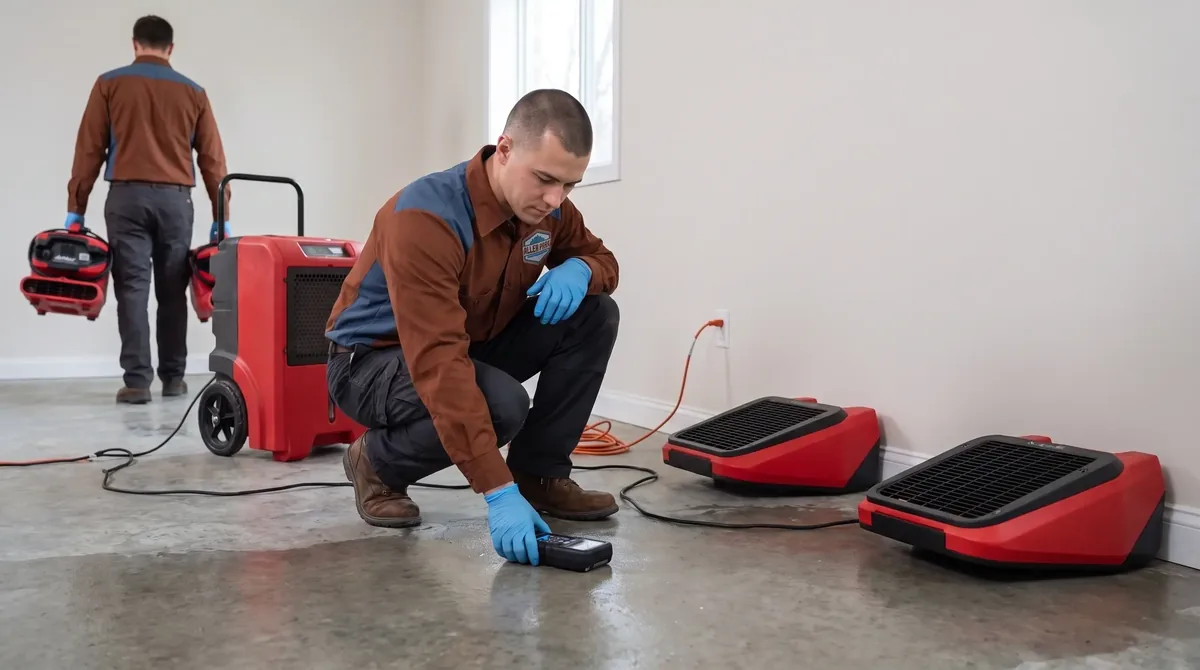
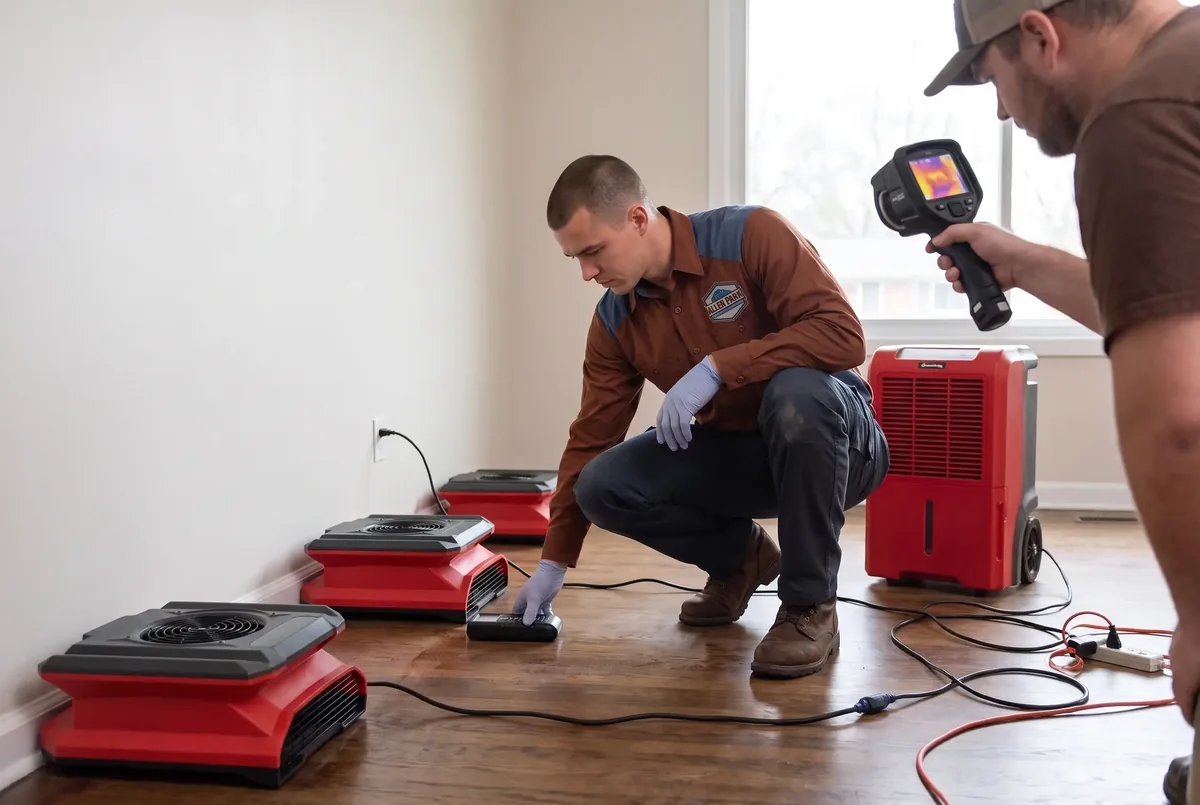
| Test what is wet | Probes and scanners tell us how deep the water went. We check the walls, the ceilings under the damaged area and the floor beneath the carpet, and we sketch a plan of the wet zones. |
| Lift out standing water | We start with pumps for deep puddles in basements and crawl spaces. Then extractors pass over carpet and tile. Wet padding and swollen trim go to the debris pile when they cannot be saved. |
| Drying with machines | Dehumidifiers and high-speed fans make a drying chamber in each wet room. Heat from the machines helps water leave the framing. Our crew tests the readings once more to prove each area is dry. |
| Paper trail | Our team logs every photo, reading and removed item with a date. The log gives your adjuster a clear view of the storm damage. Coverage choices stay with your insurance company. |
Our field kit
- Roll tarp
- Sheathing panels
- Floor extractors
- Submersible sump units
- Floor-drying fans
- Refrigerant dehumidifiers
- Moisture detection meters
- Thermal imaging camera
What you will notice
The first visit is busy. Hoses, pumps and large fans fill the wet rooms, and some wall or floor pieces may come out. The next visits are quieter. A technician checks readings, shifts machines and tells you how close the rooms are to dry. Plan for noise and a warmer house.
Questions Callers Ask Most
Do you answer calls while the weather is bad?
Yes, you can reach us. We ask what happened and give safety guidance. We send a crew once wind and lightning no longer threaten them. If you or anyone nearby faces danger, call 911 before anything else.
What happens at the start of a job?
The start is a safety review. We watch for live lines and trees that may drop. We then block the openings with tarps and boards. After that, the crew pumps water and surveys the walls and floors for moisture.
Is the rain-soaked material dried or thrown out?
Both can happen, depending on the item. Solid wood and drywall often dry in place. Insulation and carpet padding often go. We point out what we plan to remove and why, and you approve the plan.
What should be on camera for my claim?
Record each room, each stain and every broken part. Capture the source outside as well. Take them before cleanup starts. A short written list of damaged items helps your adjuster, so add one with the photos.
Can you work with no electricity?
Part of the job goes ahead. Covering openings, hazard checks and some removal need no outlet. The drying stage is different, since the machines run on electricity, so it follows once supply is safe. First, have wet panels looked at by an electrician.
What is the local picture on storm damage in Allen Park?
On Aug 19, 2014 at 5:07 pm, thunderstorm wind in Allen Park blew down six-inch tree limbs and wires and blew shingles off a roof.
What is the local picture on power outages in Allen Park?
In the same September 2026 storm, more than 110,000 DTE customers across the region lacked power at 2:40 p.m., and Allen Park was among the hardest-hit cities.
Need storm cleanup in Allen Park?
Talk to a person at (313) 306-8373.
Response in Allen Park typically runs under 30 minutes. Call and a crew is dispatched to your address right away, any hour.
On-site estimates don't cost you anything.
We back the work with a written guarantee that means a re-visit, not a payout.